
By Eteteonline
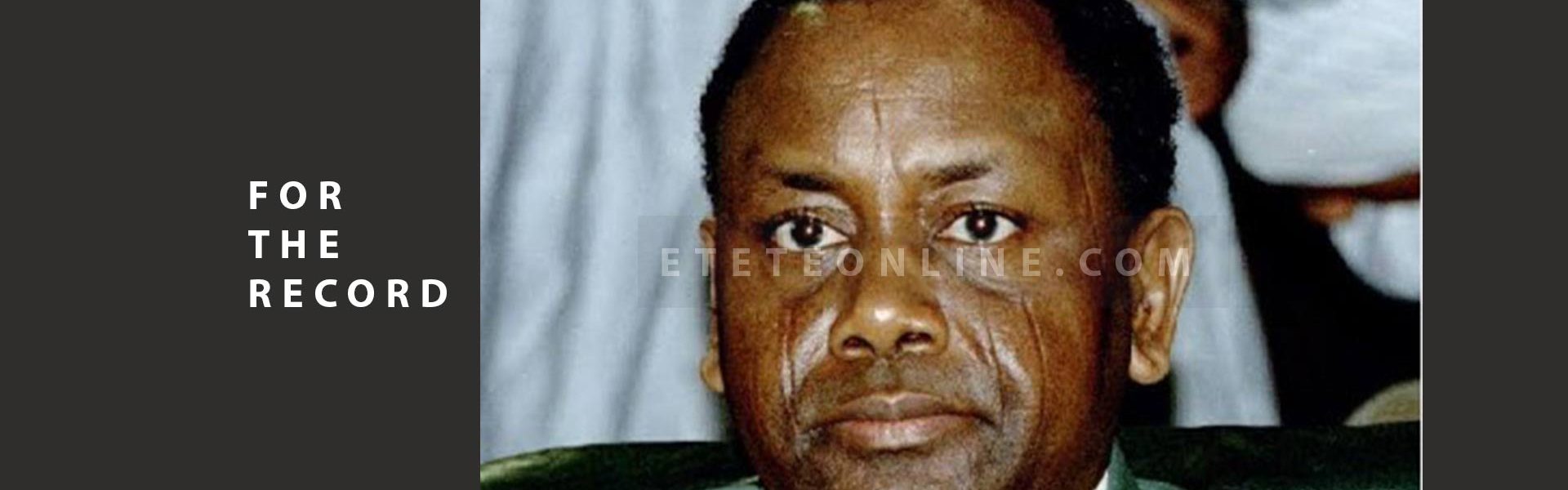
With the assumption of duty on November 17, 1993, the Abacha administration was entrusted with the onerous task of moving the nation forward. Analysts describe it as the dawn of a new era: an era of hope, peace, stability, and genuine democracy.
In the nationwide broadcast on November 18, 1993, General Abacha announced a programme of action that included revamping the economy, reforming certain public institutions, and entrenching an enduring democracy, among others.
The administration then put the necessary machinery and structures in place, one of which was the Provisional Ruling Council (PRC), to undertake this great task of national salvation. The PRC would serve as the highest policy and decision-making organ of the government.
On November 24, 1993, the Head of State, General Sani Abacha, inaugurated the Provisional Ruling Council. On the occasion, he urged the members to lead by example in line with the spirit of the new era. General Abacha said:
“You will be expected to give leadership by example. We must restore confidence in our people through exemplary behaviour, dedication, discipline, and sacrifice. We must give an account of our stewardship.”
He told them that the “administration will not tolerate any form of laxity, no matter what level of authority it is found.” The fight against corruption and other forms of indiscipline was not left out of specific areas of priority. General Abacha stated that his administration would mobilize all available resources at its disposal to fight the menace of corruption, armed banditry, and drug trafficking.
He maintained that re-orientation and rededication by all Nigerians would certainly move the nation forward: “The best way out is to reorientate our thinking and rededicate ourselves to the service of our beloved country,” he said
The Head of State appealed to Nigerians for reconciliation, understanding, and cooperation in bringing about the fulfillment of the dream of a united and progressive Nigeria. His administration, he said, is bent on “giving individuals and groups a realistic hope in the future of the country.” Quite conscious of the state of unhappiness, General Abacha appealed for support and patience:
“We cannot achieve much unless every Nigerian gives the administration enthusiastic support. We need the sympathy, understanding, and cooperation of our people and the international community in our efforts at nation-building.”
Progressive politicians joined the military administration
The new era has also witnessed progressive politicians joining the military administration in the belief that the government was heading in the right direction with a bright and promising destination. This was regarded as a major step towards the attainment of national reconciliation. These progressives included leading politicians, successful businessmen, industrialists, social critics, and pro-democracy activists with broad and liberal views on national issues. The taking up of ministerial and advisory appointments by these eminent Nigerians was seen not only as a great stride in moving the country forward but also as an acceptance and approval of the philosophy, vision, and mission of General Sani Abacha’s administration. He explained the presence of these progressives in government in the following terms:
“It is pertinent to stress that this administration does not represent any political party of whatever persuasion and of any period of our history. We know we have brought into the mainstream of our administration eminent Nigerians and political leaders from past political parties. This is with the hope that balance, experience, and maturity, which are so dearly needed at this period of our national history, would be freely placed at our nation’s disposal. At this crucial time, we need an efficient, cohesive, and high-calibre team in the affairs of the state. I congratulate all the members of our team who have made enormous sacrifices for our country at this time.”
Their participation in the Abacha government, however, drew criticisms from some quarters. The critics, described as shallow-minded, questioned why these progressives should like to serve in a military government. The criticisms were dismissed by others who saw such participation as a call to national service at the most crucial time in the nation’s history. It was the view of these great Nigerians that they could not stand by and watch the nation gradually slip into anarchy, civil war, and disintegration. They said their conscience would not stop pricking them, and posterity would never forgive them. Alhaji Baba Gana Kingibe was the National Chairman of the defunct Social Democratic Party (SDP) and later the running mate to Chief MKO Abiola in the annulled presidential election. He was first appointed Minister of Foreign Affairs and later Minister for Internal Affairs. Shortly after his swearing-in as Minister of Foreign Affairs, he stated that he accepted the appointment in order to “create a basis for Nigerians to reconcile and decide their future”. He, like the other progressives, believed strongly in the unity, peace, and stability of Nigeria and was ready to put in his best to enable his dreams to come true. Alhaji Kingibe’s comments were carried by the Vanguard of November 26, 1993, in which he stated further:
“I don’t think I can stand back when circumstances and events lead us to a position of imminent collapse.
“I am satisfied with the responsibility. I am here with all my heart, and I will put in all my energy. I know the expectation of my people and the international community, but I know I shall triumph.
The Foreign Affairs Minister expressed confidence in the ability of General Abacha to lead the nation to greater heights: “I have confidence in my Head of State. And I am encouraged by his determination to ensure a change of events.”
Another important member of the progressives to serve in the Abacha Administration as Minister of Works and Housing was Alhaji Lateef Jakande, a former civilian Governor of Lagos State. In an interview with Weekend Vanguard of May 27, 1995, he had this to say of the state of the nation and why he participated in the Administration of General Sani Abacha:
“The nation was in danger of disintegration. Everything was at a standstill. Nobody expected that things would calm down so soon and that Nigeria would still be a strong, united country that it is today. I was, by the grace of God, part of the instruments that God used to ensure the survival of the nation. That survival is now assured.”
He said that he did not regret serving in the government of General Abacha. It was a thing of pride and joy to him:
“I am very happy that I did what I did last year. I am very proud that I served in the Abacha Administration. As at the time we came in, the country was on the verge of disintegration.”
Alhaji Jakande said he joined the administration with the primary goal of saving the nation from disintegration. “That cause of saving the country was more important than any other cause”. He then queried how he would have felt if Nigeria had been allowed to break up. He wondered how such an occurrence would have been explained:
“I would never have forgiven myself. I am grateful to God that I was part of the team that saved Nigeria. I am grateful that I did what I did.”
With the institutions of government firmly on ground, the stage was set for national salvation, the first step being national reconciliation.



Add comment