
By Eteteonline
Rise through the ranks
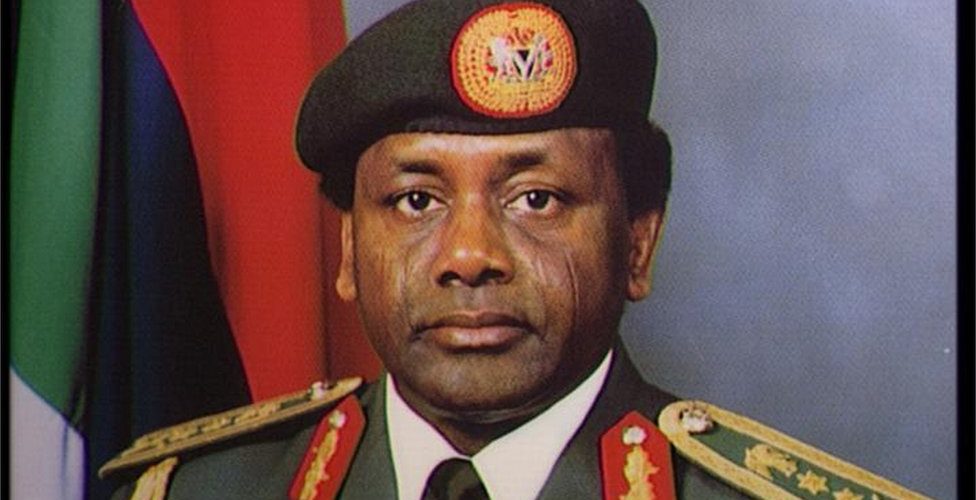
On November 17, 1993, a Child of Necessity was born in Nigeria, and a new administration came into being to tackle the socio-economic and political problems that the nation experienced at the time. The man at the helm of the administration was General Sani Abacha. Many Nigerians sought to know more about the General.
A child was born in Kano on September 20, 1943, into a Kanuri family. He was brought up like his contemporaries, not knowing what the future had for him, because this was embedded in the womb of time. The child who grew up to be a general in the Nigerian army was Sani Abacha.
Sani Abacha acquired his primary education at the City Senior Primary School, Kano. Thereafter, he proceeded to the Provincial Secondary School (Government College, Kano) for his secondary education. With this foundation, a high standard and a rare opportunity at that time, Sani Abacha enrolled in the Army in 1962. This marked the beginning of his long, enduring, and patient military career.
In 1962, he received his first military training at the Nigerian Military Training College (NMTC), Kaduna, and was commissioned Second-Lieutenant the following year. In 1963, he was admitted for further training at the MONS Defence Officers Cadet Training College in Aldershot, United Kingdom. He completed that course and returned to Nigeria in 1964. Upon his return, he attended the young officers’ course at NMTC, Kaduna. Between 1966 and 1971, General Abacha returned to the UK and acquired more training at the School of Infantry, where he did courses on Military Intelligence and Company Commanders. Back at home, he was admitted into the Command and Staff College, Jaji, in 1976. He completed the course and obtained the Passed Staff College (PSC). The Kano son later enrolled at the National Institute for Policy and Strategic Studies, Kuru, Jos, in 1981 and obtained his Member National Institute (MNI). He also passed through the Senior Defence International Management Course, California, U.S.A., in 1982. From 1963, when he was commissioned Second Lieutenant, Sani Abacha passed through all the ranks in the Nigerian Army. He was promoted to Lieutenant in 1966 and Captain in 1967. In 1969, he became a Major. He rose to the rank of Lieutenant-Colonel in 1972, Colonel in 1975, Brigadier in 1980, Major-General in 1985, and Lieutenant-General in 1987. Sani Abacha was promoted to General in 1990. His journey up the ladder has not been a rosy one. Sources maintain that the infantry genius worked very hard and has been well committed to his military career. General Sani Abacha has held several posts in the Nigerian Army since 1962. He has served as a Platoon Commander, Battalion Commander, and Commander Infantry Department of the 2nd Infantry Division. He was appointed General Staff Officer grade two, Battery Commander, Brigade Commander, and Assistant Quartermaster General 2 Division. In 1984, he became General Officer Commanding (GOC) 2 Mechanized Division. He was appointed Chief of Army Staff in 1985 and later Chief of Defence Staff and Minister of Defence. His designation was changed to Secretary of Defence in the Interim National Government. General Sani Abacha became the Head of State and Commander-in-Chief of the Armed Forces of the Federal Republic of Nigeria on November 17, 1993, following the resignation of Chief Ernest Shonekan as head of the Interim National Government.
Appeals for intervention
Even though Nigeria was on the brink of catastrophe, the majority of Nigerians wanted peace. They wanted to get along with their lives devoid of harassment, intimidation, and the constant threat of war. In order to find a way forward and out of the mess in which the country found itself, many Nigerians, including pro-democracy and human rights activists, opinion leaders, and traditional rulers, openly called for military intervention to save the nation. Indeed, some foreign governments joined in the call for the military to intervene. They said only the military could arrest the drift and avert the impending doom. In its “Annual Report on Human Rights in Nigeria, 1993”, the Civil Liberties Organization (CLO) had the following to say of the call for military intervention:
“Some prominent pro-democracy activists began to call for military intervention. This call was made by Gani Fawehinmi and Dr. Olu Onagoruwa on the grounds that only the military could arrest the drift that was gradually settling on the nation. Especially, with the way the National Assembly had gone.”
The position was restated by General Sani Abacha in an address to opinion leaders. He said:
“The truth of the matter is that some of you here present today and many who are now pretending otherwise appealed to us to intervene and arrest the drift of those dark days. Even the representatives of some foreign governments made similar appeals to us to save the nation from imminent collapse and disintegration.”
This popular agitation for military intervention was finally heeded on November 17, 1993, when the Head of the interim National Government resigned. And the most Senior Minister (Secretary as it was then called), who was General Sani Abacha, took over as Head of State. A short press statement on November 17, 1993, read as follows:
“Following the resignation of the Head of State and Commander-in-Chief of the Armed Forces of the Federal Republic of Nigeria, this 17th day of November, 1993, General Sani Abacha (GCON), takes over from Chief Ernest Shonekan as the Head of State and Commander-in-Chief of the Armed Forces of the Federal Republic of Nigeria on 17th November, 1993.”
In light of the intervention, many Nigerians believe that the Abacha administration came just at the right time. As General Abacha himself put it, he responded, “We patriotically and in accordance with our professional calling.” A little more delay would have been catastrophic for the nation.
A Child of Necessity is born: Abach addresses the nation
On November 18, 1993, the Head of State, General Sani Abacha, delivered his maiden address to the nation:
“Fellow Nigerians, sequel to the resignation of the former head of the Interim National Government and Commander-in-Chief of the Armed Forces, Chief Ernest Shonekan, and my subsequent appointment as Head of State and Commander-in-Chief, I have had extensive consultations within the armed forces hierarchy and other well-meaning Nigerians in the bid to find solutions to various political, economic and social problems which have engulfed our blessed country and which have made life most difficult to the ordinary citizens of this nation.”
He described the state of the nation as desperate and saluted Chief Shonekan for his patriotism, courage, and selfless service to the nation:
“Chief Ernest Shonekan took over as Head of State and Commander-in-Chief of the Nigerian Armed Forces in the most trying time in the history of our country. Politically, economically, and socially, there were lots of uncertainties. Things appeared bleak, and the atmosphere was heavy with uncertainties. However, driven by the belief in himself, his countrymen, and love for his country, he accepted facing the challenges of our time. I would therefore like to take this opportunity to pay tribute to him for his selfless service to the nation. He showed great courage in taking on the daunting task of heading the Interim National Government, even a greater courage to know when to leave.”
The Head of State acknowledged the apparent return of the military, but stated that it was necessary to enable the nation to come out of its predicament:
“Many have expressed fears about the apparent return of the military. Many have talked about the concern of the international community. However, under the present circumstances, the survival of our beloved country is far above any other consideration. Nigeria is the only country we have. We must lay a very solid foundation for the growth of true democracy. We should abhor any ad hoc or temporary solutions. The problems must be addressed firmly, objectively, decisively, and with all sincerity of purpose.”
Consequently, he announced the dissolution of the Interim Government, national and state assemblies, state executive councils, local government councils, the National Electoral Commission, and the two political parties. Also, Decree 61 of 1993 was abrogated. General Sani Abacha announced the establishment of the Provisional Ruling Council, which will be vested with legislative power.
On security, the strike embarked upon by workers and the closure of some media houses, he said:
“Our security system will be enhanced to ensure that the lives of citizens and, properties of individuals are protected and preserved. Drug trafficking and other economic crimes, such as 419, must be tackled and eliminated.
“On the current strike throughout the nation, following the increase in the price of fuel, l appeal to all the trade unions to return to work immediately. We cannot afford further dislocation and destruction of our economy. The fuel issue will be looked into.
“On the closed media houses, the government is hereby lifting the order of proscription with immediate effect. We, however, appeal to the media houses that in this spirit of national reconciliation, we should show more restraint and build a united and peaceful Nigeria.”
The Head of State recounted briefly the events that led Nigeria to its present predicament:
“Fellow Nigerians, the events of the past months, which started from the annulment of the June 12 election, culminating in the appointment of the former Head of State, Chief Ernest Shonekan, are well known to you. The economic downturn has undoubtedly been aggravated by the ongoing political crisis. We require well-thought-out and permanent solutions to these problems, if we have to emerge stronger from them.”
As a way forward, therefore, the future constitutional structure of this country will be examined through a constitutional conference, and major institutions will be reorganized and reformed:
“Consequently, a Constitutional Conference with full constitutional power would be established soon to determine the future constitutional structure of Nigeria. The constitutional conference will also recommend the method of forming parties, which will lead to the ultimate recognition of political parties formed by the people. While the conference is on, the reorganization and reform of the following major institutions will be carried out: the military, the police, the customs, the judiciary, NITEL, NNPC, NEPA, the banking industry, and our higher institutions of learning.”
He said the regime will be firm, humane, and decisive, and will not tolerate any act of indiscipline. He appealed to the international community to refrain from passing judgment “while we grapple with the onerous task of nation building, reconciliation and repairs.” Thus, a child of necessity was born to move the nation forward. According to General Abacha:
“This government is a child of necessity with the strong determination to restore peace and stability to our country, and on these foundations enthrone a lasting and true democracy. Give us a chance to solve our problems in our own ways.
“Finally, l appeal to all Nigerians, particularly our community, our traditional rulers and leaders, for their maximum support and cooperation.
“Long live the Federal Republic of Nigeria.”
The intervention of the military was generally hailed as the dawn of a new era. In a communique released by the NATIONAL MOVEMENT FOR PEACE AND STABILITY entitled “The Only Way Forward,” the group had this to say of the misfortunes of 1993:
“For the better part of 1993, Nigeria and Nigerians were on a tight rope. There was paralysis in almost all the facets of our national life. There was a strike in this or that sector; there was a shortage of this and that. The educational sector, from the primary to university levels, was in shambles. The universities were shut by military fiat for months. The sector was riddled with banking strikes that brought untold hardship to the populace. The prevailing anxieties and uncertainty led the productive and distributive sectors to near paralysis. Throughout the year 1993, everyone and everything was not at peace. The 17th November 1993, termination of the ING reign, however, offered a respite when it came.”
This group praised the emergence of the Abacha Administration for having to grapple with the problems of bringing the nation back to the path of peace and stability – economically, socially, and politically:
“If nothing else, the emergence of General Abacha and his men on the terrain last November 17 brought a halt to a disastrous drift to the abyss of anarchy and disintegration, the likely precarious end of which no one could predict. If nothing else, the Abacha Government has brought relative hope and peace, which, with the effort of all, could culminate in a firm atmosphere for lasting peace and concrete stability.”
In another reaction, an SDP chieftain and former governorship candidate in Enugu State said there was no alternative to the General Sani Abacha-led intervention if the country was to remain one entity. He made the remarks shortly after the swearing-in of the members of the Provisional Ruling Council. He said further:
“Any honest Nigerian would accept the fact that some politicians, especially amongst the Governors and lawmakers, have lost their direction. What General Abacha has done has a far-reaching effect on the oneness of this country. It could have been worse, because the country was already slipping into dismemberment.”
Many people from all shades of political opinion spoke out in support of the Abacha-led intervention. To them, this will reduce tension in the country and accelerate the process of national reconciliation, an essential ingredient needed to move the nation forward. Nigerians generally denounced the politicians for trying to turn this country into a battlefield for their own personal gains. It was rather pathetic when the majority of the elected governors and assemblymen from the States and Federal Houses refused to support, defend, and protect the emerging democracy. They rather fueled the crisis and aggravated the tension with unguarded public statements. This attitude tended to support the assertion by some groups, including the Association for a Better Nigeria (ABN), that a solid foundation had not been laid for democracy or that the political class was not yet ready.
This state of unpreparedness resulted in the collapse of the democratization process. The Abacha Administration accordingly announced the dismantling of all existing democratic structures. This was also greeted with relief by many people who said it would pave the way for a new beginning, thinking, and orientation. The transition program, initiated by the government of General Sani Abacha and well on course, would afford Nigerians the opportunity to sit together and talk and work out an acceptable way forward.
According to some critics, the dismantling of all democratic structures meant the return of full-blown military rule. However, most Nigerians believed that the return of the military, full-blown or otherwise, which guaranteed peace, unity, and stability, was better than the half-baked democracy that was leading the nation to destruction. Thus, the administration of General Abacha was seen as the symbol of this much-desired peace, unity, and stability.



Add comment