
By Eteteonline
Local contractors’ protests over unpaid federal government debts are a significant developing story in Nigeria.
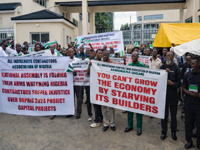
Due to outstanding bills owed by the Federal Government, contractors affiliated with the All Indigenous Contractors Association of Nigeria (AICAN) have begun large-scale protests in Abuja, mostly at the Federal Ministry of Finance. blocked the entrances to the finance ministry: Enraged by the non-payment, protesters blocked Dr. Doris Uzoka-Anite, the Minister of State for Finance, from accessing her office. Although no injuries were recorded, tensions increased when security personnel allegedly fired a gunshot into the air to disperse or control the gathering.
Until the estimated N4.7 trillion in arrears are paid, the local contractors have threatened to take over Abuja’s streets. The contractors protested on Monday, January 19, 2026, claiming the government had failed to release the funds allocated to them in the 2024–2025 budgets.
Protests against the federal government’s debt to contractors have been going on since at least the middle of 2025; therefore, this is not an isolated incident.
In order to highlight their predicament, local contractors have often staged protests at the National Assembly and Ministry of Finance, blocking doors and carrying symbolic objects like coffins.
According to contractors, the Federal Government owes around ₦4 trillion for completed projects, especially major works from 2024.
According to AICAN, numerous members are in financial trouble as a result of the government’s persistent failure to fulfill payment obligations.
Prolonged payment delays for completed government projects under the 2024 and 2025 budgets, as well as the incomplete or nonexistent delivery of verified payment warrants in spite of ministers’ guarantees, are the causes of the protests.
Many members, according to contractors, have experienced loan defaults, property seizures, and extreme financial difficulty as a result of nonpayment.
A portion of the House of Representatives called for the executive to resolve delays and suspended plenary to demand payment of unpaid contractor bills.
The Abuja Administration’s bills were the reason for smaller contractor organizations’ protests against the FCTA, which were occasionally greeted with police tear gas.
The larger problem of unpaid federal contractor debts has prompted the Federal Government to take certain actions. A ₦100 billion provision to start paying off local contractor debts is included in the planned budget for 2026.
President Bola Ahmed Tinubu established an interministerial committee in late 2025 to deal with the backlog of contractor payments. But the contractors claim that despite these actions, actual cash payments are still insufficient or have stopped, which is what is causing the protests to continue.
The AICAN president, Jackson Ifeanyi, said, “Whenever the government sets up a committee, it is often to divert attention. As we speak, no payment has been made.”
“If any was made, it probably went to foreign contractors. Our calculation shows the debt is over N4.7 trillion.
“Government gives warrants without cash backing. It’s like giving a check that you can’t cash at the bank. This system is killing the real sector and real investors,” Ifeanyi claimed.
Deeper financial and governance issues with government project execution and budget implementation are reflected in these protests. They draw attention to the discrepancy between budgetary allotments and actual payments, particularly for capital projects carried out by regional businesses.
Prolonged nonpayment can strain economic confidence, deter private sector involvement in governmental projects, and damage domestic contractors.


Add comment