

By Eteteonline
Role of the Association for Better Nigeria
The events and circumstances surrounding the annulment of the June 12, 1993, presidential elections actually began on Thursday, June 10, 1993, when an Abuja High Court restrained the National Electoral Commission from conducting the presidential elections. The suit was at the instance of the Association for a Better Nigeria (ABN). The ABN, hitherto an unknown group, became very popular due to the role it played in destroying or disrupting Nigeria’s journey to democracy.
The Association succeeded in creating confusion and crisis, which threw the country into a state of panic. Initially, not much was known about this Association except that it was pro-military and was campaigning for the extension of military rule for another four years. The campaign started after the cancellation of the first presidential primaries and the disqualification of the twenty-three aspirants.
Initially, the campaign of the ABN was clandestine. Billboards and Newspaper advertisements were used. Afterwards, the campaign became public. The inscription read “four more years of peace, unity, and stability”. One of the reasons for the anti-civil rule campaign was an intra-party squabble within the Social Democratic Party at its national convention held in Jos between 27 and 29 March 1993. The ABN alleged irregularities and fraud during the conduct of the presidential primaries from which Chief MKO Abiola emerged as the SDP’s flag bearer and concluded that the electoral process was corrupt and undemocratic. It was the stand of the ABN that the political class was not yet organized and that the democratic foundation was still shaky or fragile. The ABN further maintained that it was premature for the Babangida Administration to quit office on August 27, 1993, without putting a sound economic foundation in place.
Apart from the public campaign of the ABN, the group initiated a court action to achieve its goal. While it sought an extension of military rule in the substantive suit, the ABN asked for an interlocutory injunction to restrain the National Electoral Commission from conducting the presidential election on June 12 until the substantive issues were disposed of. On June 10, less than 48 hours before the elections, Justice Bassey lkpeme granted the application for interlocutory injunction, maintaining that “It will be wrong of me to sit down and encourage NEC not to investigate allegations of corruption in politics.”
The judge described allegations made against some Governors as “the greatest shame in the history of Nigerian politics.” The National Electoral Commission, on its part, relied on section 19 of Decree 13, which provided as follows:
“Notwithstanding the provision of the Constitution of the Federal Republic of Nigeria, 1979, as amended, or any other law, no interim or interlocutory order or ruling, judgement or decision made by any court Or tribunal before or after the commencement of this Decree in respect of any intra-party or inter-party dispute or, any other matter before it, shall affect the date or time of the holding of the election or the performance by the commission of any of its functions under this decree or any guidelines issued by it in pursuance of the election.”
NEC’s objection that the court lacked jurisdiction by virtue of the above provision was rejected. In the historic ruling, the judge declared as follows:
“I am convinced that I have jurisdiction to hear this matter. NEC is not to determine a stable stage for democracy but only to conduct an election, and the decree cited by NBC does not preclude me but encourages NEC to disregard any ruling. NEC is hereby restrained from conducting the presidential election pending the determination of the substantive suit before the court.”
The injunction slammed by the Abuja High Court restraining the NEC from conducting the presidential election was followed by outrage, considering the long and elaborate preparations. Consequently, the National Defence and Security Council (NDSC), the highest decision-making organ of the government, met to consider the matter. Later, NEC issued a statement saying it would go ahead with the election as scheduled, ignoring the court injunction. NEC’s position was that the High Court had no jurisdiction to restrain it from conducting the election.
The Electoral Commission went ahead with the election. Its officers went into the field. Local monitors and international observers shuttled around the country, giving information and situational reports on events. Registered voters trooped out in their hundreds and thousands to polling stations. Accreditation and other formalities took place as planned, and the election was conducted under the modified open ballot system. At the end of polling, fourteen out of thirty-nine million registered voters had cast their votes.
NEC proceeded with the collation of figures around the country. Then, results started coming in from the states. Results from fourteen states were approved and released by the NEC in Abuja and showed the Social Democratic Party’s candidate, Chief MKO Abiola, comfortably in the lead.
The NRC objects to the election results
Meanwhile, supporters of the National Republican Convention (NRC) lodged a protest with the NEC over the dress worn by Chief Abiola on the election day to the polling centre where he cast his vote. The protest letter was captioned “Contravention of Decree 13 by SDP presidential candidate Bashorun MKO Abiola”. The protest letter stated that by wearing the traditional outfit which carried the colours and symbol of the SDP, Chief Abiola had violated the provisions of section 49, (2)(e) of the Presidential Election (Basic Constitutional and Transitional Provisions) Decree No. 13 of 1993. The said section provides that offences on the day of polling shall include:
“Wearing, exhibiting or tendering any notice, sign, token, symbol, slogan, badge, photograph or party card, other than a voting card referring to the election.”
Copies of the protest letter were said to have been sent to the president, the Chief Justice, and the Attorney General of the Federation. According to the text of the letter:
“Going by the evidence so far adduced, the SUP presidential candidate, Bashorun Abiola, stands disqualified in the presidential race, and I therefore urge the National Electoral Commission to effect the electoral penalties on Bashorun Abiola immediately.”
However, all aggrieved persons were told to channel their complaints to the right quarters; apparently, a reference to the Election Tribunal, which was constituted to hear and determine petitions arising from the election.
When the results of the 14 states and Abuja were announced on Monday, June 14, the NRC insisted that the election should be cancelled. This was contained in the statement signed by its publicity secretary. This position contradicted an earlier pledge by the two parties to accept the election result as the people’s verdict. The NRC launched a fierce attack on NEC for what it called “piecemeal” release of results, which was a reference to the first 14 states and Abuja. According to the statement released by the NRC:
“This is a deliberate action calculated to mislead and incite the general public. Already, different versions of what are purported to be the results of the presidential elections are being circulated all over the federation with the aim of causing chaos and anarchy.”
The statement maintained further that the electoral laws provided for the Chief Electoral Officer of the Federation only to announce the final results and should not be done piecemeal, as it was being done by the NEC. It insisted on sanctions against the SDP for alleged violation of electoral laws:
“The NRC is again asking NEC not to shirk its responsibility of upholding the electoral laws which were violated by the SDE presidential candidate, Bashorun MKO Abiola, who on the election day canvassed for votes by wearing, carrying and displaying the flag and symbol of SDP at the polling station in Lagos where he voted in total contravention of Section 49(2)(e) of Decree 13 of 1993.
The NRC statement also complained of the court injunction, which sought to prevent the election some hours before it was due to take place. It said that the injunction had a demoralizing and undemocratic effect on the general voter turnout all over the country:
“The majority of the NRC supporters, for example, were disenfranchised, particularly in the rural areas of the North and the riverine areas of the country as a result of this inadequate and poor communication.”
Perhaps the NRC was yet to make its strongest protest on the conduct of the election. It did not hesitate to do so, as its statement revealed. It said:
“Information reaching us revealed that the elections in most parts of the country were massively rigged and voters intimidated, thus leading to total falsification of results emanating from most states.
“Monetary inducements were overtly and widely used throughout the country by the SDP and its supporters to lure voters into voting for the SDP presidential candidate.”
The NRC expressed its utmost dissatisfaction with the presidential election. And on what it wanted NEC to do in respect of the allegations, the statement concluded:
“The National Republican Convention wishes to formally make it known its total dissatisfaction with the conduct of the presidential elections, and therefore calls on all Nigerians to reject the result of the elections in its entirety as it is not a full reflection of the will and wishes of the electorate. We are also calling on the National Electoral Commission to cancel the results of the presidential elections and order fresh elections throughout the country as soon as possible.”
The complaint lodged by the NKC did not end there. Its presidential candidate’s campaign organization sent a petition to the NEC in which it demanded that Bashorun MKO Abiola be disqualified for contravening Decree 13 of 1993, or, in the alternative, cancel the election and organize new polls.
It was not only petition writing. NRC supporters in some States took to the streets. Minna, the capital of Niger State and an NRC stronghold, came alive when NRC supporters took to the streets in a peaceful protest against the election. In a large convoy of vehicles and led by the State Chairman of the party, the protesters drove through the streets of Minna, alleging fraud, rigging, and bribery during the election, and calling for the cancellation of the results.
The court declares the election illegal
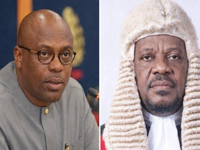
In the meantime, while results from the remaining sixteen states were being awaited, and in the midst of the storms and protests, the Association for a Better Nigeria (ABN) went to court again seeking another injunction to restrain the NEC from publishing the remaining results. The suit was instituted by the National Coordinator of the ABN. By the time the case was being heard, the sixteen states had submitted their results to the NEC in Abuja. However, while the nation was eagerly waiting for the results to be officially published, an Abuja High Court presided over by the Chief Judge of Abuja, Mr.
Justice Dahiru Saleh, who heard the application for injunction, granted the prayers sought. By this injunction, NEC was restrained from announcing the results pending the disposal of the application in Court 9, a reference to an earlier application which almost prevented NEC from conducting the presidential election.
Funny enough, as some observers put it, NEC decided to obey this particular order of the court and suspended further announcement of results. This time around, it could not rely on Section 19 of Decree 13 again to defy the court order. Moreover, contempt proceedings had begun against the commission for disobeying an earlier court order not to conduct the election in the first place.
As pressure and criticisms mounted for the release of the election results, the Federal Capital Territory Chief Judge, Mr. Justice Saleh, declared the presidential election illegal because it had earlier been stopped by a High Court Order, which was disobeyed by the NEC. The election was not proper and therefore not legal, he said in the ruling. This was the second suit instituted by the ABN, and the ruling was given barely a week after His Lordship issued the injunction that stopped the announcement of results.
Public Reactions
This development was like a bombshell. There was anguish, disappointment, and confusion. Politicians, social critics, interest and pressure groups called for the release of the remaining results. This call was followed by an appeal to SDP supporters to remain calm. Its national Secretary, Alhaji Sule Lamido, said that they should not allow themselves to be provoked. “Nigerians have spoken their minds and have elected the leader of their choice,” he declared, and they should rejoice for their ability to organize a free, just, and fair election for the first time.
Many Nigerians denounced the way and manner in which the courts granted injunctions. They said the court was the last hope of the common man and should not make a mockery of the legal process or destroy the faith and confidence the people have in it. In the view of Dr Tai Solarin, the court injunction could plunge the country into crisis, and he warned of the activities of some Nigerians who were bent on tearing the country apart. This, he said, was unacceptable.
Arguments, comments, and consultations went on across the nation. The legality or illegality of ABN’s actions continued to capture attention and occupy the headlines. Lawyers had a field day debating the issues. Matters did not end here; some aggrieved members of the public who claimed to have voted in the election and were entitled to know the results, initiated actions in other High Courts to compel the NEC to release the remaining results. Consequently, a Lagos High Court, after hearing the application, ordered NEC to release the results and announce the winner. Similar orders also came from the Ibadan, Jos, and Benin High Courts, respectively. However, these orders were not obeyed by NEC.
The speaker of the Osun State House of Assembly, in calling on NEC to release the election results, said:
“It is disheartening to note that the NEC, which did not respect a court injunction to conduct the election, now performs below expectations when it has respected an injunction not to announce the results of the election.”
The Nigerian Medical Association drew attention to the adverse consequences that the tension and anxiety may have on the healthcare delivery sector. In a statement issued by the Association, its Secretary General said:
“It must be realized that the delay in releasing the poll’s results has led to the heightening of anxiety among Nigerians, and the fears of unrest would have led to hypertension. The nation’s health care delivery system is in such a deplorable situation that it cannot receive and manage casualties satisfactorily from any nationwide civil disobedience.”
Other reactions came from the National Association for the Advancement of Democracy and the Association of Nigerian Authors. All these reactions, comments, and criticisms took place amidst official silence. The official silence and inaction to resolve the impasse became another source of worry to the public.
A government spokesman said that NEC had not reported any problem it was confronting since the beginning of the deadlock. This, however, did not deter people from calling for government intervention.
Federal government intervention
There was a popular call for the government, particularly the president, to intervene and break the impasse. A statement signed by the Senate President and the Speaker of the House of Representatives appealed to the President to “direct the National Electoral Commission to release the results of the presidential election without further delay in the interest of the unity, peace, and stability of this our great nation.”
The president was reported to have preferred the due process of law to take its course. However, the National Defence and Security Council NDSC) Fixed meetings on June 23 and 24 to deliberate on national issues, including the stalemated presidential election. The Secretary for Justice, Mr. Clement Akpamgbo, on June 22, said that “The government is not insensitive to what is happening. Luckily, the National Security and Defence Council will meet on this matter by tomorrow. Nobody is happy about what is going on.”
The NDSC met on June 23, but the decision regarding the election result came as a surprise to the nation. The Federal Government annulled the election. In a Special Statement released in Abuja by the Press Secretary to the Vice President, all actions pending in the High Courts and Court of Appeal relating to the presidential election were scrapped.
The two Decrees, namely, Numbers 52 of 1992 and 13 of 1993, which were to usher in a democratically elected president, were repealed. The statement said further:
“All acts or omissions done or purported to have been done, or to be done by any person, authority, etc. under the above-named Decrees are hereby declared invalid. The National Electoral Commission is hereby suspended. All acts or omissions done or purported to be done by itself, its officers or agents under the repealed Decree No. 13 of 1993 are hereby nullified.”
On June 26, the President addressed the nation on the decision of the NDSC to annul the election. He said the two candidates spent over two billion naira during the primaries in contravention of the regulations. Though the election was generally acclaimed to be free and fair, it was marred by irregularities, he said. The president also mentioned the existence of a conflict of interest between both aspirants and the government, “which would compromise their positions and responsibilities were they to become president”.
The SDP abandoned Abiola’s mandate
After the annulment, the government announced the holding of a fresh presidential election to conclude the transition programme. The SDP insisted on the recognition of the June 12 election and unequivocally rejected fresh elections at its Benin meeting on July 5, 1993. Governors in SDP-controlled states had a marathon meeting in Kaduna and reaffirmed their no-fresh-election position. They agreed that they “will not participate in, or in any way assist any purported fresh presidential election during the transition period.”
The apparent hardline position adopted by the SDP was insurmountable and not negotiable. It was maintained in words and in action. The party refused to cooperate with the NEC and the NRC to hold a fresh presidential election. In a letter the SDP sent to NEC, it was stated in part as follows:
“We affirm and remain committed to the June 12 election. We are firm, we are resolved that the SDP will not participate in any election for the duration of this transition programme.”
However, the SDP was soon to abandon its claim to the June 12 election, which it said was sacrosanct, inviolable, and non-negotiable. The party leadership suddenly changed sides, shifted grounds, and was singing a different tune. The struggle and commitment to the recognition and enthronement of the June 12 election came to an end. The meeting between NEC and the two political parties settled for an interim national government. The following Communique was issued at the end of the tripartite meeting:
“Following our continuing resolve to find an acceptable political solution to the present political impasse and the need to avoid further violence and bloodshed, the end of which may be unpredictable and unimaginable, we, the two political parties, have resolved to revisit the option of Interim National Government as a way out of the present crisis in the greater national interest.”
The Communique was signed by the SDP and NRC National Chairmen. The decision to abandon the June 12 election by the SDP was communicated to the government. A committee was set up to work out the modalities for the take-off of the interim national government. Its terms of reference included the structure, tenure, composition, and mandate of the ING. This committee comprised representatives of the two parties and was headed by the Vice President.
The crises
Between June 23, when the election was annulled, and August 26, when the Interim National Government took off, Nigeria was engulfed in different forms of crises. This period was described by some observers as one of the darkest in Nigeria’s history, which took the nation many years back. One factor was the polarization of Nigerians. Two factions, namely, the pro-democracy and the pro-military, emerged. The antagonists fought an undeclared war among themselves and set Nigerians at loggerheads with one another. The weapons were threats, intimidation, blackmail, and propaganda. The battlefields were the print and electronic media. Seasoned, well-trained, and highly respected journalists were involved. Archivists went for the records, and historians dug into the past. Facts hitherto unknown came to light, and startling revelations were made. Some sounded credible and others purely speculative. Each camp tried very hard to score some points.
The pro-democracy group was portrayed as a destabilizing agent that wanted nothing but destruction for Nigeria. On July 16, the Federal Government said it had uncovered plans by a “terrorist group” to foment trouble and destabilize the country. It said the strategy of the terrorist group was to create fear and a feeling of insecurity among Nigerians. Other tactics of the terrorists, it said, included the recruitment of hoodlums to carry out arson in some urban areas and intimidation of relatives of public officers through the issue of death threats to them.
On another occasion, the Federal Government said it had uncovered a plan orchestrated by a fleeing field marshal to destabilize the nation. It was also alleged that some aggrieved politicians were planning to carry out sporadic explosions of bombs in three cities (Lagos, Abuja, and Kaduna) to create an atmosphere of insecurity. The plan included the blowing up of the North-South Oil pipeline at a point which is a few kilometres from Kaduna and the stepping up of acts of incitement. The aggrieved politicians were also said to have stockpiled weapons in a neighbouring country with the intention of waging war on the nation. There was even an allegation that the pro-democracy group had signed a pact with a foreign superpower to invade Nigeria.
The pro-democracy group also had its turn. It did its best to discredit, taint, and smear the personality of military men, especially the officer corps, through a campaign of disinformation, distortions, and blackmail. The atmosphere was charged with threats of war. Nigeria was being compared to Bosnia, Liberia, and Somalia, where ethnic strife has torn the people apart in fratricidal wars, which have caused great human suffering.
Tribal sentiments received official recognition and were encouraged. The spirit of unity and love among Nigerians was steadily being replaced with hatred, suspicion, and contempt. Some Nigerians openly called for stiff sanctions against their motherland. They asked the Security Council of the United Nations, the European Union countries, and the United States of America to impose punitive sanctions without delay. This was in addition to the limited sanctions already imposed by some countries. The United States of America had suspended government-to-government aid and halted the exchange of defence materials with the Nigerian Military. The United Kingdom recalled its instructors from the National War College and suspended some financial aid. The United States also stopped direct air links with Nigeria on the grounds of inadequate security.
The above sanctions seemed insufficient; some Nigerians called on the United States, a major purchaser of Nigerian oil, to stop buying the commodity. This was supported by some American Congressmen who insisted that they had done it before to some other countries and could do the same to Nigeria. All this happened at a crucial time when Nigeria was experiencing gross economic depression and crisis; when every aspect of the nation’s economic life was completely paralyzed and in great shambles; when investments had come to a standstill; and when massive withdrawals of money from banks and movement of capital out of the country assumed a pathetic but unstoppable dimension.
There were demonstrations for and against the annulment. In some places, the demonstrations were hijacked by hoodlums popularly referred to as “area boys” who took the opportunity to intimidate innocent and law-abiding members of the public. They extorted money from people and looted shops. Cars were set ablaze. There was friction and tension between different ethnic groups. Perhaps the most disturbing aspect of the crisis was the decision of some top politicians and elites to beat the drums of war and secession if the remaining results of the presidential election were released. Propagandists, rumour mongers, and speculators also beat the war drums and repeatedly warned of an impending doom. They used all available means at their disposal to spread their devilish message of doom and evil. Peace-loving Nigerians, however, tried to calm down tension, appease the combatants, and proffer advice on the way forward for the nation. A columnist in the Guardian Newspaper, in an article captioned “Averting the impending doom,” said:
“Since the nullification of the June 12 election, 1 have had this strange feeling of foreboding that we are heading for some disaster.”
This renowned columnist pointed out that the trend of events showed a disastrous war in the making. He said the pro-democracy group will seek support from America and the Western powers to preserve democracy, while the pro-military group will seek support from the Middle East on the pretext of fighting a holy war. And the country will “be embroiled in a politico-religious and ethnic cleansing war”. The columnist said further:
“All the irredentist movements will rise to settle old scores with their neighbours. Border clashes will flare up into full-scale ethnic cleansing (Yugoslavian style). In the meantime, the OAU, ECOWAS heads of State, United Nations will be meeting and passing resolutions.
“It will be a field day for arms-dealers too. All the obsolete equipment in their arsenal (tokunbo tanks and tokunbo fighter planes) will find a ready market in Nigeria. After some time, the United Nations Security Council will pass resolutions limiting arms sales to both sides. That will only ensure that the illegal dealers get paid higher prices for the arms.
“In the meantime, who suffers? We, the people of Nigeria, one side or the other, will pledge the oil for arms; external debts will snowball as there will be no debt-servicing as long as the war lasts.”
Fear and tension gripped the nation. A cloud of uncertainty descended on Nigeria.
The natural consequence of this was that Nigerians could no longer feel safe in any part of the country other than their home of origin. There was an exodus of panic-stricken people fleeing to different parts of the country. Many People with landed property sold them and ran home. The flight to ethnic bases intensified despite the assurances of safety and security by the government. People fled from all parts of the country because they feared being caught in a devastating war.

Add comment