
By Our Archivist
- On December 31, 1983, the Second Republic civilian administration of Alhaji Shehu Shagari was toppled by the Armed Forces.
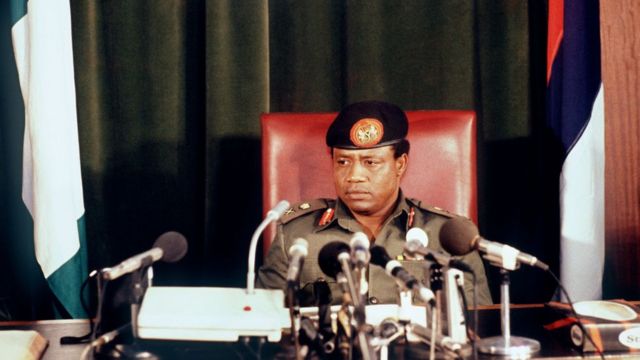
- On January 1, 1984, Major General Muhammadu Buhari was announced as the Head of State. Major General Tunde Idiagbon was the next in command.
- On August 27, 1985, Major General Ibrahim Babangida came to power after toppling Muhammadu Buhari.
- On January 1, 1986, President Babangida announced a programme that would pave the way for the return to democracy in Nigeria in 1990.
- The Babangida administration inaugurated the Political Bureau on January 13, 1986, to kickstart the transition programme. The Bureau consisted of 17 members, with Dr S.J. Cookey as the head.
- Political Bureau submitted its report to the government on March 27, 1987.
- A committee, headed by Major General Paul Omu, was mandated to scrutinize the report, prepare a draft white paper, and submit the same to the AFRC. The Omu committee recommended extending the final disengagement of the military from 1990 to 1992.
- In July 1987, the much-awaited white paper was published. The transition programme would terminate military rule on October 1, 1992.
- The inauguration of the Constitution Review committee followed. The Committee comprised 46 members and was inaugurated on September 7, 1987. Justice Buba Ardo headed it.
- A Constituent Assembly was set up with Justice Anthony Naemezie Aniagolu as its Chairman.
- The National Electoral Commission (NEC) was inaugurated in Abuja in 1987 with Professor Eme Awa as chairman.
- On July 25, 1987, the President inaugurated the Mass Mobilization for Social Justice, Self-Reliance, and Economic Recovery, popularly referred to as MAMSER.
- The Electoral Commission under Professor Awa conducted the local government council election on December 12, 1987.
- The ban on political parties was lifted on May 3, 1989.
- Thirty political associations emerged, but only 13 applied for registration. NEC recommended six associations to the AFRC for registration.
- The six associations were the People’s Solidarity Party (PSP), Labour Party (LP), People’s Front of Nigeria (PFN), Nigerian National Congress (NNC), Republican Party of Nigeria (RPN), and Liberal Convention Party (LCP).
- The AFRC rejected the six associations and approved the registration of two political parties, namely the Social Democratic Party (SDP) and the National Republican Convention (NRC).
- On December 8, 1990, local government elections were held. With the creation of 136 additional local government areas, another local government election was held on November 23, 1991.
- On December 8, 1990, local government elections were held. With the creation of 136 additional local government areas, another set of local government elections was held on November 23, 1991.
- On December 14, 1991, elections were held in the State Houses of Assembly and State Executive Councils, completing the process of democratization at the state level.
- On July 4, 1992, elections were conducted for the Senate and House of Representatives.
- Presidential primaries were held in September 1992, involving 12 aspirants for the SDP and 11 for the NRC. There were allegations of rigging and bias by the candidates, the electorate, and some party officials.
- Consequently, the AFRC invoked the provisions of Section 101 Decree 19 of 1987, dissolved the executives of the two parties at all levels, and in their places, caretaker committees were set up with Alhaja Lateefat Okunnu as National Chairman of the NRC and Air Vice Marshal Ishaya Shekari (rtd) as National Chairman of the SDP.
- Then, it became impossible for the transition to be completed within the scheduled time, which was to terminate on January 2, 1993.
- In line with the new timetable, elections were conducted in ward, local government, and state congresses as well as the national executives of the two political parties. Dr Hammed Kusamotu emerged as the National Chairman of the NRC, and Chief Tony Anenih was elected the National Chairman of the SDP.
- Following the party conventions in Jos and Port Harcourt in April 1993, presidential candidates emerged. Chief MKO Abiola was elected as the SDP candidate, and Alhaji Bashir Othman Tofa was elected under the NRC banner. The two candidates picked their running mates. Ambassador Baba Gana Kingibe was chosen as Chief Abiola’s running mate, while Dr Sylvester Ugoh became the running mate to Alhaji Tofa. The presidential election was held on June 12, 1993, as scheduled. However, on June 23, the Federal Military Government annulled the election.
- New officers were appointed for the National Electoral Commission (NEC) with Professor Okon Edet Uya as the National Chairman.
- An Interim National Government (ING) was formed under the headship of Chief Ernest Shonekan, a renowned businessman from Ogun State. On August 26, 1993, the Babangida administration handed over power to the ING.
- The ING’s mandate was to conduct a fresh presidential election in February 1994 and hand over to a democratically elected president by March 31, 1994.
- However, on November 17, 1993, the Head of the ING, Chief Ernest Shonekan, resigned.
- General Sani Abacha, Secretary (Minister) of Defence, took over in what was generally described as a coup.


Add comment