
By Correspondent
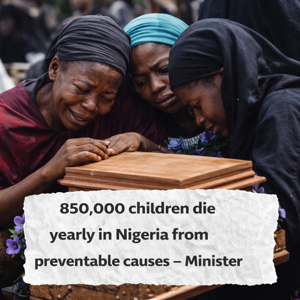
According to Muhammad Pate, the Coordinating Minister of Health and Social Welfare, Nigeria loses about 850,000 newborns and children under five each year to avoidable causes like pneumonia and preterm.
Nigeria has made quantifiable strides in lowering the number of fatalities among children under five, but it is still far from reaching international goals, according to Mr. Pate, who was accompanied by John Urakpa, the Director of Health Promotion.
Nigeria’s under-five mortality rate decreased by 45% over the course of two decades, from 201 deaths per 1,000 live births in 2000 to 110 deaths per 1,000 in 2023, according to statistics from the Nigeria Demographic and Health Survey (NDHS).
According to the minister, of these deaths, 162,000 are attributed to pediatric pneumonia annually, and 280,000 babies pass away during the first 28 days of their lives as a result of complications from premature birth.
According to estimates from around the world, there are about 100 million instances of pediatric pneumonia each year, which leads to about 808,000 deaths.
He claimed that the majority of this cost falls on low- and middle-income nations, especially those in sub-Saharan Africa.
He said: “Nigeria and 14 other countries account for nearly three-quarters of the global childhood pneumonia mortalities.”
“These unfavourable indices, and those of other childhood killer diseases, are still responsible for the high under-five mortality rate of 110 per 1,000 live births as reported by the 2024 NDHS,” he stated.
Mr. Pate referred to childhood pneumonia as the “forgotten killer of children under five,” claiming that although the world community has mobilized heavily against HIV, malaria, polio, and tuberculosis, pneumonia has not received the same attention despite being a significant cause of child fatalities.
The minister attributed the recent decline in child fatalities to the ministry’s collaboration with the Paediatric Association of Nigeria and the Every Breath Counts Coalition.
“Despite this modest progress, approximately 850,000 preventable newborn and under-five deaths are predicted to occur annually,” he said, warning that “Nigeria is not yet on track to achieve the Sustainable Development Goal target of a rate less than 25 per 1000 Live Births by 2030.”
According to him, the partnership resulted in the creation of an In-Patient Pneumonia Treatment Algorithm that has “improved secondary and tertiary healthcare workers’ clinical skills in treating severe and complex pneumonia.”
After considerable engagement with important partners, the ministry created the Nigerian Child Survival Action Plan (NCSAP) to expedite progress.
“Addressing factors across each of these sectors is essential for fulfilling children’s developmental potential and survival,” Mr Pate said.
“There is no room for complacency. The Ministry will continue to explore innovative partnerships that will translate our efforts into effective action for child survival,” he said.
By 2030, the plan seeks to lower under-five mortality to less than 25 deaths per 1,000 live births by combining child protection, nutrition, education, and health in a multi-sectoral strategy.




Add comment