
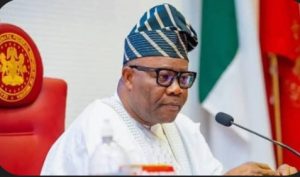
By J. Archibong
On December 9, 1962, Godswill Obot Akpabio was born in Essien Udim Local Government Area (LGA) of the Akwa Ibom State.
He attended the Methodist Primary School in Ukana, Essien LGA; Federal Government College in Port Harcourt, Rivers State; the University of Calabar in Cross River State; and the Nigerian Law School in Lagos. In Lagos, Akpabio participated in the mandatory National Youth Service Corps.
He was a teacher at Afaha Secondary School in Essien Udim, an Associate Partner at Paul Usoro & Co. in Lagos, and the Director of Corporate Affairs/Legal Services at EMIS Telecoms Limited.
When then-Governor Obong Victor Attah named Godwill Akpabio the Honorable Commissioner for Petroleum and Natural Resources in Akwa Ibom State in 2002, he entered the political spotlight. He held the position of Commissioner in three important ministries from 2002 to 2006: Chieftaincy Affairs/Lands and Housing, Local Government, and Petroleum and Natural Resources.
He ran for governor of Akwa Ibom State because of his commitment to public service. He had benefited from the power shift that had given the Ikot Ekpene Senatorial District political leadership. Godswill Akpabio emerged as the PDP’s nominee for the governorship elections in Akwa Ibom State after defeating roughly 57 other candidates. He became the third civilian governor of Akwa Ibom State on May 29, 2007, after winning the governorship in the 2007 general elections.
When Chief Godswill Akpabio was sworn in as the third democratically elected governor of Akwa Ibom State and the ninth in the state’s leadership line, the people of the state experienced a generational shift and change. A number of years of injustice, exploitation, marginalization, poor management, and backwardness were reversed by his inauguration, which was a turning point.
Governor Akpabio started a revolution as soon as he took office in order to improve the state by building infrastructure and providing the populace with efficient services. The government outlined the tenets, timeless guidelines, and plans outlining how the state will enhance the economy, roads, welfare, education, and utilities. The governor and the state as a whole received many honors and recognitions for these and other accomplishments.
Since assuming the role of leader, he has strived to free the populace from poverty and backwardness by operating on certain unusual principles and breaking new ground.
The extensive urban revitalization and rural transformation initiative that Senator Akpabio’s administration implemented is one of his lasting achievements. In order to improve the state’s metropolitan regions’ overall aesthetics and infrastructure, the government launched the urban redevelopment initiative. In order to build a strong basis for the state’s development, the administration also changed tactics and intensified its efforts, one of which was allocating 80% of its budget to infrastructure.
The Akpabio administration’s major priority was to provide water, electricity, roads, and other essential facilities to every community in the state. He transformed Akwa Ibom into a massive construction site complete with flyovers, bridges, and highways. Significant progress was accomplished in the economy and infrastructure during the eight years in office.
The four pillars of Akpabio’s road infrastructure plan were the construction of drainage systems, road dualization, road repair, and new road construction. With deep gullies and deadly craters vying for space at various points along almost every road, state and federal, the highways had turned into death traps.
Every new road built during the Akpabio era has covered drains connected to a flood erosion control plan as part of the road maintenance activities. The state capital’s roads are drained of rainwater within minutes of each significant downpour, according to state officials. To reduce traffic in the city core, the Akpabio administration built a number of flyover bridges.
Akpabio remarks that he became enraged and finished the abandoned Uyo International Airport project so that his state’s citizens could travel straight to other regions of Nigeria and beyond. The airport allowed Akwa Ibom people to travel from all over the world because it could accommodate large aircraft like the Airbus 380.
The Ibom Power Plant, which can produce 191 megawatts of power, was completed by the administration. The Akpabio administration also accomplished something that had never been done before in the field of rural electrification. The national grid was connected to more than 1600 localities. As a result, the state’s electricity coverage increased to at least 85%.
The Godswill Akpabio International Stadium, which is today the best in Nigeria and unquestionably among the best in Africa, was one of the many projects he started and finished. The Allianz Arena served as the basis for the state capital of Akwa Ibom, Uyo, which is home to a state-of-the-art multipurpose sports complex with 30,000 seats.
Chief Akpabio started the process to revitalize the state’s economy after taking office in 2007 by inspiring the public sector and energizing the private sector. The state’s economic blueprint, which aimed to accomplish development, job creation, and prosperity, was the catalyst for the economy’s revitalization.
As the Akpabio administration moved to boost investment and diversify the economy, the economic policies created a favorable climate for expansion and investment. Foreign investors were given incentives by the government, which ensured the security of their investment. This led to an increase in investment and tourism, as well as faith and confidence in the economy. Increased economic activity resulted in the creation of jobs for a large number of young people in the state without jobs.
Through the development and execution of a tourist and cultural roadmap, Akpabio aimed to establish Akwa Ibom State as a major travel destination in Nigeria. One of his main goals was to put Akwa Ibom “on the map” to increase tourism. The Ibom Tropicana Entertainment Center, the government’s showpiece project, was developed to increase local tourism. The Tropicana would feature six Cineplex theaters, two five-star hotels, an international convention center that can accommodate roughly 7,000 people, and an American-style shopping center. He upgraded and invested in the Ibom Le Meridien Hotels and Golf Resort to promote business and tourism in the state.
The Free and Compulsory Education program was one of Governor Akpabio’s greatest gifts to the people of Akwa Ibom State. The administration made this effort to guarantee the state’s children’s right to an education. All Akwa Ibom children of school age were required to attend primary through senior secondary school for free under this policy. As Akwa Ibom State developed into a multicultural metropolis, the administration was deeply concerned about what would happen to the children who were not attending school. Children were removed from the streets by the Akpabio government, which also prevented them from traveling to Lagos and Abuja to work as housemaids.
The foundation of the health policy was better access to high-quality medical treatment. This required establishing a statewide primary healthcare program and related facilities. Governor Godswill Akpabio made it possible for many towns in the state to have a hospital, even if they were unaware of the possibility. He claimed that his administration’s primary goal of offering the public high-quality healthcare was the reason why resources and time were wasted trying to find answers to the state’s numerous health problems.
By guaranteeing that residents of the state would not have to travel outside for medical care, the Godswill Akpabio administration altered the course of the health sector. In order to do this, the government built a cutting-edge specialty hospital that is regarded as the best in Nigeria. Both the current and former state governors were supposed to receive treatment at the hospital, which would allow the state to save money on the therapy.
Through its many initiatives and projects, the administration created 1,500 direct employment possibilities in addition to nearly 4,000 jobs for Akwa Ibom people under the commercial agriculture program. In the livestock and fisheries subsector, the government authorized N11 billion for the accelerated livestock and fish production program (ALFIPP).
About 4,500 women were empowered under the state government’s Integrated Farmers Scheme, which received significant funding totaling billions of naira. Each participant will receive N250,000 to launch an agro-related business, according to Chief Akpabio. Additionally, each local government area would have a small-scale industry to increase job creation, and a favorable business climate would be fostered for potential investors.
In order to encourage entrepreneurship, the state government established a qualitative infrastructure that would spur the state’s quick development and created an atmosphere that was conducive to the establishment and growth of small and medium-sized businesses as well as large-scale companies.
Following his resignation as governor, Chief Akpabio’s constituents told him that they believed he was still capable and urged him to agree to serve as their senator in 2015. Accepting the clarion call, he ran for and was elected to the Senate on behalf of the Akwa Ibom North-West Senatorial District (Ikot Ekpene) on the platform of the People’s Democratic Party (PDP).
On July 28, 2015, the Senate President declared Senator Akpabio to be the Senate Minority Leader after the South-South PDP caucus approved his nomination. As a first-term senator, this was exceptional and uncommon.
In his capacity as Senate Minority Leader, Godswill Akpabio established a new standard for Ibom State’s constituency briefings and empowerment by providing his residents with goods valued at millions of naira. The Senate Minority Leader position was held by Senator Akpabio from July 28, 2015, till August 7, 2018. After defecting to the APC, he resigned as Senate Minority Leader in August 2018.
In order to further the region’s vision, President Muhammadu Buhari appointed Akpabio Minister in charge of the Ministry of Niger Delta Affairs (MNDA) on August 20, 2019, after recognizing his leadership skills and track record of success in public service.
Given his heritage of development in Akwa Ibom State, people around the Niger Delta region enthusiastically welcomed his nomination as Minister of MNDA. Many praised President Buhari for the appointment, saying it was like placing a square peg in a square hole. “Nigerians should expect higher performance, commitment to service, and dedication to the country,” Akpabio said upon taking office, adding that the populace could anticipate a great deal of unusual representation and unusual performance that would lead to unusual accomplishments.
The Petroleum Industry Act, the New Regional Master Plan, the Forensic Audit, and the 3% host community development are just a few of the numerous changes that the government has implemented through the MNDA with the goal of transforming all areas of regional activity. In particular, the forensic audit greatly enhanced the ability of several service providers to deliver services, including correcting the poor performance of numerous contractors involved in the major areas of the region’s development operations.
Akpabio gave Delta, Akwa Ibom, and other states in the area new hope for projects that had been put on hold. Senator Akpabio’s transformation plan gave long-abandoned projects in the Niger Delta new hope for completion. Prince Anthony Ekene Onwuka, Special Assistant, Project Monitoring and Special Duties, Presidential Monitoring Committee on the NDDC, gave an explanation of the Committee’s work and how the Minister of Niger Delta Affairs was altering the long-suffering region’s development dynamics.
Under Akpabio, the Ministry accomplished a great deal that touched all of the states in the area. According to Akpabio, all of these and other initiatives showed a complete dedication to giving the residents of the oil-producing area a purpose in life. In the Nine Niger Delta States, he finished and put into service a number of projects.
Senator Akpabio made sure that six local government districts in the Ondo South Senatorial District had access to power, among many other energy-related projects. For the previous fourteen years, the locals had lived in complete darkness.
In order to guarantee that residents have access to basic healthcare services, the MNDA gave healthcare in the area priority. Bringing healthcare services to people’s doorsteps, offering free consultations, medications, and referrals when needed, as well as offering expert advice and information on preventive and treatable measures, were the goals of the Ministry’s Medical Outreach Program.
Under his direction, the NDDC conducted workshops on disease prevention, community health awareness campaigns, and training for rural health extension workers. Restoring functional healthcare access in remote, difficult-to-reach riverine areas was the goal of these initiatives.
The Niger Delta state governments received medical supplies, personal protective equipment, ventilators, test kits, and sanitizers from the MNDA/NDDC under Akpabio during the COVID-19 pandemic. The Ministry funded awareness efforts in rural communities and provided equipment and beds to isolation centers. In states that were initially ill-prepared for the epidemic, these steps improved health systems.
His educational programs were a component of a larger plan for the development of the Niger Delta. In the remote Niger Delta, Akpabio improved access to schooling.
He increased youth empowerment programs, including vocational training, business support, project-based job creation, and participation in development initiatives, after realizing that youth unemployment and restlessness were significant obstacles and causes of instability in the Niger Delta. As a result, the Niger Delta policy made youth empowerment a central component.
Known as “the man who turned boys into men,” he put a high priority on empowering young people in order to bring about peace in the area while serving as governor of Akwa Ibom State. In order to achieve this, Senator Akpabio used the Ministry’s youth empowerment initiative to equip roughly 1600 young people with a variety of skills within his first 100 days in office.
His election as the Senate’s tenth president was a watershed, a huge victory for Nigeria, and a huge step forward for the APC. Nigerians have a bold leader in Akpabio who would stand up for the country’s common good when necessary. The 10th Senate has been led by Senator Akpabio with dignity, simplicity, candor, and generosity.
The generosity with which he distributed the senators’ committee heads was especially noteworthy. There was no animosity or unfairness in this distribution.
Akpabio’s deliberate leadership of the Senate in the areas of oversight and accountability has led to lively discussions and careful consideration of all viewpoints before decisions are made.
The 10th Senate is highly serious about its oversight role. The government’s ministries, departments, and agencies (MDAs) and their respective jurisdictions have been contacted by its numerous committees. The Senate acts as a watchdog, holding the executive branch responsible, thanks to the president’s dedication to preserving democratic principles. Under his direction, he has reinforced the Senate’s commitment to progressive government, economic empowerment, and national development.
Under Akpabio’s direction, important areas, including infrastructure, healthcare, education, job development, and security, have been given top priority in national budgets. A significant step in easing the financial challenges experienced by Nigerian workers was taken on July 23, 2024, when the National Minimum Pay Bill was enacted, increasing the minimum pay from ₦30,000 to ₦70,000.
The most extensive change in Nigeria’s fiscal system was accomplished when the Senate approved four landmark tax reform legislations. The tax reform proposals’ overarching goals are to promote a more equal tax system, increase tax compliance, and boost economic growth.
Under Akpabio, the 10th Senate passed legislation on regional development commissions to hasten regional development, and all of these laws were enacted into law. This is the SWDC, or South-West Development Commission. The North-West Development Commission (NWDC) and the South-South Development Commission (SSDC). The North-Central Development Commission (NCDC), the North-East Development Commission (NEDC), and the South-East Development Commission (SEDC) are further organizations.
On April 3, 2024, the President signed the Student Loans (Access to Higher Education) (Repeal and Re-enactment) Bill into law after it was approved by the Senate. In order to provide students with interest-free loans for their higher education, it creates the Nigerian Education Loan Fund (NELFUND) was created.
Akpabio’s Senate has pushed for federal financing to upgrade hospitals and healthcare facilities, giving priority to health programs in a number of states. This includes improving impoverished people’s access to necessary medical care by concentrating on mother and child health initiatives in rural areas.
As Nigeria continues to face challenges from bandits, militants, and other criminal forces, national security has remained a primary issue for the Senate. Under Akpabio, the Senate approved large budgetary increases for the military, police, and intelligence services in recognition of the nation’s complicated security environment, guaranteeing that these organizations had the means to deal with new challenges.
In response to Nigerians’ unrelenting demands, the Senate established a 45-member Constitution Review Committee in February 2024, led by Deputy Senate President Barau Jibrin. The review will tackle complex problems such as election reforms, the establishment of a state police, and increased women’s participation in governance through the granting of special seats in parliament.
The Senate’s contribution to promoting foreign relations under Akpabio’s direction is noteworthy. In a brief time in this Senate’s existence, diplomatic relations have been reinforced, encouraging cross-border cooperation. In order to ensure that Nigeria’s interests are adequately represented on the international scene, the Senate has evolved into a forum for interacting with international partners.
Delegates from all across the world elected Senator Akpabio to a three-year term on the Inter-Parliamentary Union (IPU) Executive Committee. With his election, Akpabio broke a 59-year-old jinx, making his appearance as a member of the Executive Committee in October 2023 extremely significant for Nigeria. Nigeria last enjoyed the honor of serving on the Executive Committee in 1964.
Chief Godswill Akpabio has credited God’s grace for his accomplishments. He has remarked that without God’s assistance, he would not have experienced the unusual transformation.
In appreciation of his services to the country’s growth, Senator Akpabio has won numerous national and international honors, including Grand Commander of the Order of the Niger (GCON), Nigeria’s second-highest national honor.
The administration of Eteteonline wishes Senator Akpabio many more years of good health, God’s grace, protection, and extraordinary accomplishments as he celebrates his 63rd birthday.

Add comment